
Although he has traveled around the world and lived in places like Saipan and Hawaii, one thing is absolutely clear to David Kupferman: he wouldn’t want to be anywhere but right here in Vermont. “Actually living here is incredible,” he shares. “Vermont has everything my family could want, and there is no end to the thankfulness we feel that we are able to be here.”
The family found a strong community in Jericho, where they’ve lived since 2023 when Kupferman accepted the position of Dean of the Schools of Arts & Communication and Education, Psychology, & Social Science at VTSU. Much of that connection comes from the local school and the kids’ sports teams, which Kupferman volunteers to coach in his free time. He and his wife Jennifer have a blended family of four children, including two elementary school-aged kids who live with them in Vermont. That sense of community and connection is important to him at work too, and is reflected in the values he brings to his work at VTSU.
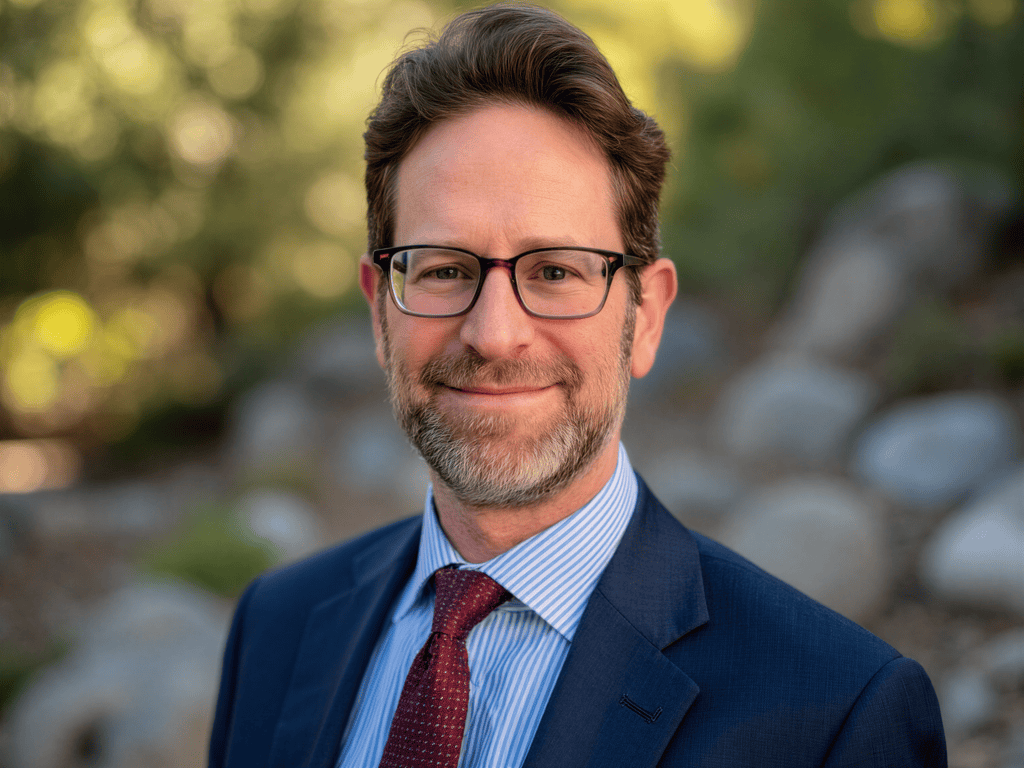
“Existential opportunities” in higher education
Kupferman started at VTSU as the university entered its first academic year following unification. The role is both his favorite job he’s ever had, and one he feels is the best fit for his personality and skills. And he brings a different outlook to where higher education is headed. “People talk about an existential crisis in higher education. I think we have existential opportunities,” he said.
Having experienced the traditional faculty track himself, albeit out of the traditional order, Kupferman was drawn to the VTSU position for its ability to have a far-reaching impact. “There are over twenty programs across the two schools I lead,” he noted. “It’s a wide breadth of subject areas. Each one of them is transformative to individual students. Positioning myself to impact those students and to make the experience at VTSU better over time for them as well as for faculty and staff is what drew me here.”
He also describes the uniqueness of the Vermont State Colleges system, where public higher education opportunities at the community college as well as the undergraduate and graduate levels are available and have tremendous future potential. “We can make the future happen,” he shared. “It doesn’t necessarily just happen to us. And this moment we’re in right now, where the university will have the opportunity to turn the page on its next chapter as we welcome a new president, that’s exciting too.”
It’s a great responsibility to hold and honor the institutional memory of the legacy colleges while also thinking about what is next for the university and the world. So much of the role Dean Kupferman is in is defined by the circumstances of unifying those three colleges, five campuses, and online learning. Yet, he’s been surprised most by how folks step up and pitch in in Vermont. The same resiliency he’s witnessed in Vermont’s communities is echoed at VTSU.
“Community is built in small movements and small moments”
For Kupferman, based at the Johnson campus, the University has both tremendous responsibility and a huge role to play in its rural community. With two years of floods impacting the town and a resulting loss of services in the community, lingering impacts of COVID, and lower in-person enrollment on that campus, he sees a real opportunity to rethink the campus in a way that will serve the student population and area residents in a unique way.
His philosophy is both simple and a challenge to each of us: We each drive change.
“As humans, we build community in small movements and small moments. It’s not one big thing, it’s the consistency and the presence. The interaction between students, faculty, staff, the campus, and the community. When we can strengthen those networks over time and one step at a time, we build something better, together.”
He cites the current build-out of the nursing program at Johnson as a success story, as it will attract additional students to campus, provide new career advancement opportunities for local residents, and bring the ability to formulate new community partnerships to the university.
He’s also inspired by the psychology students interning at the Laraway School, a therapeutic school in the community that serves children and families in need of enhanced support. Laraway provides an essential service to the Lamoille County community and VTSU’s students are gaining experiences that will benefit their own future profession while making connections that further both themselves and the University’s mission.
Additionally, the university recently sold McClelland House, an unused building adjacent to campus, to Downstreet Housing and Community Development for the purpose of developing affordable housing and senior housing in the Johnson community. It’s a creative way to use existing buildings to fill a community need and bring more community members to the campus, while partnering with a mission-driven organization positioned to deliver those services to the community.
All of these moments, he says, build connections, strengthen the community, and help drive the region’s economic growth.
At the same time, reflecting on the inflection point the university is in, he admits that no one has the right answer at every moment. As the institution develops a new culture, he reflects that there is a balance between where and what VTSU would like to be and where VTSU is. The needs of the state, students, economy, workforce, and region are front of mind. And the student experience is the foundation of it all. “It’s this amazing balancing act,” he says. “And I wouldn’t want to be anywhere else.”
A non-traditional path through teaching and administration
It was in a job early in his career teaching that Kupferman realized how quickly his influence could spread. “I had 25 students, they each had 25 students. My work was going to filter out into a large number of teachers and kids and the idea of that was really meaningful to me.” As he immersed himself in his field of study, educational foundations, it became even more acute.
Kupferman taught middle and high school in Saipan, Santa Fe, New Mexico, and then took a teaching role at a college in Micronesia. He describes it as a surreal experience as unexpectedly, within a week of arriving, he was elected chair of the education department. Shortly after, he became Dean of Academic Affairs.
“It was this inverse of what the traditional faculty to administration pipeline is,” he shared. He ultimately remained there for nine years, working on his Ph.D. in Educational Foundations from the University of Hawaii at the same time. With that degree, he was able to return to the regular academic track as an assistant and then associate professor for the next decade.
When COVID hit and he and his wife Jennifer were juggling two jobs, a newborn, and virtual Pre-K for another child, he began looking for something new. “It was a very reflective time,” he noted. “My research focus had shifted and I was looking at future studies, what the future of education and institutions would be. It got me thinking that now was the time to make a career move in higher ed if I was going to do it.”
He applied for and was accepted to the MBA program at Boston University, which gave him the flexibility to look for opportunities that fit his desired next step: higher education administration. “I knew things were going to change irrevocably in the post-COVID period, so I set the goal of getting myself into the role of a decision maker at a higher education institution,” he added. “About three years ago, I saw the posting for this position at VTSU. I was intrigued as it seemed like exactly what I was looking for.”
He went through the hiring process from Norway, where he was leading a study abroad tour with twenty-six students. He stayed for a few extra weeks to travel with his family, and describes interviewing with the hiring team with the fireworks from Norway’s Constitution Day celebrations in the background. He accepted the job and moved to Vermont in July.
Building Human Connection
As Dean Kupferman reflects on what VTSU and its people need right now, he shares that it all comes back to that critical human sense of community and connection. It’s something he drives home as a core value of his leadership style too. When he’s on one of the five campuses, he’s in offices and checking in with folks. He adds, “those moments of human connection are fewer and farther between since COVID, and more so in a dispersed model. But it’s essential to getting work done that we develop these relationships and make human connections.”
Even on the days his kids are on break from school, he’s on campus as much as he can be. While his five and seven year old equate their dad’s work with the brownies at the Johnson cafeteria, Kupferman hopes that they learn something from seeing his efforts to build human connection too.
When he’s not at VTSU, you may be able to find Dean Kupferman walking Atreyu, his Bernese mountain dog, down his dirt road, Nordic skiing, or reading a Scandinavian noir crime novel. You might also find him at a comic shop, as he’s been collecting X-Men, Batman, Superman and the Fantastic Four since he was a kid. As for his career aspirations, he’s living in the extraordinary moment VTSU is in, and grateful for the opportunity to serve its students, the university, the state colleges system, and the state of Vermont.
We want to hear from you!
Are you a VTSU faculty member who’d like to be included in a future Faculty Spotlight? Want to nominate a faculty member to be featured?
