
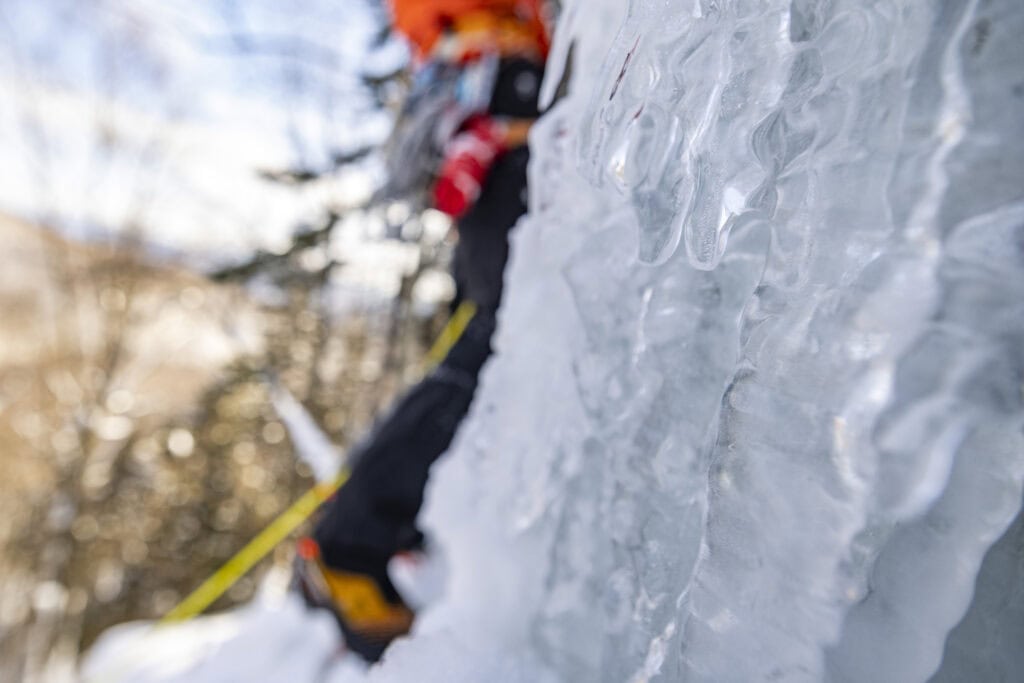
VTSU Professor Benjamin Mirkin and student Carson Zundel, of the VTSU Outdoor Education, Leadership & Tourism program, participated in conducting this research surveying participants of the Mount Washington Valley Ice Fest.
Explore the data below, and look forward to future academic writing on the topic from our community.
The Mount Washington Valley Ice Fest Survey Report
Benjamin J. Mirkin, Eleanor Weisman-Rowell, Carson H. Zundel, James N. Maples, Ryan L. Sharp
Executive Summary
This report examines the user experiences, demographics, and economic impacts of participants at the 32nd annual Mount Washington Valley Ice Fest in New Hampshire. This event attracted an estimated 750 participants, with most living 35 or more miles from the Mount Washington Valley.
Notable findings include:
- Participants at Ice Fest spent an estimated $375K as a result of attending Ice Fest. This includes ~$35K from persons living nearby and $340K from persons living 35 or more miles from the Mount Washington Valley.
- Expenditures from Ice Fest supported $118,927 in wages and added $239,787.90 to the region’s Gross Domestic Product.
- Participants were highly educated, with approximately 4 of 5 visitors holding at least a Bachelor’s degree and 35% holding a graduate degree.
- Participants reported a great deal of satisfaction with evening programming and offered feedback on additional clinics of interest for Ice Fest 2025.
- Participants expressed a deeper interest in adding events and speakers focused on diversity and inclusion
List of Tables
- Table 1: Descriptive Statistics, Ice Fest Participants
- Table 2: Use Patterns, Ice Fest Participants
- Table 3: Ice Fest Participation and Use Patterns
- Table 4: Feedback on Ice Fest Clinics and Workshops
- Table 5: Ice Fest Merchandise and Evening Programming Feedback
- Table 6: Local resident per person expenditure patterns as a result of Ice Fest
- Table 7: Visitor per person expenditure patterns as a result of Ice Fest
- Table 8: Economic Impact of Ice Fest 2025
Event Summary
The Mount Washington Valley Ice Fest (henceforth Ice Fest) occurred January 31-February 2, 2025. This event is now in its 32nd year and represents the premier ice climbing event in the northeast United States. Ice Fest included guided climbing opportunities with equipment provided, clinics on ice climbing topics, and evening entertainment events. The festival occurs in the Mount Washington Valley (New Hampshire), a celebrated ice climbing and winter mountaineering destination. The Mount Washington Valley is also famed for its waterfall ice climbing opportunities.
Survey Methods
Data for this study are from a survey of 750 Ice Fest attendees, guides, and volunteers (henceforth collectively labeled as participants). In all, 258 participants completed the survey, which offers a representative sample (95% confidence with 5% margin of error). The survey was released from Feb 1-March 15, 2025 via email lists and related social media to ensure a wide participant response. The survey (available upon request) focused on participant use patterns, demographics, festival experiences, and expenditures while at the festival. The survey (available upon request) focused on participant use patterns, demographics, and expenditures while ice climbing in the region and replicated questions common to recent peer-reviewed climbing studies. [1] [2]
Post-data collection, the anonymous survey responses were downloaded into Excel for cleaning. Cleaning included removing cases with no responses and/or who declined to participate, transitioning word responses into numbers (“seven” into “7”), removing odd responses (such as a year with five numerals), turning numeric ranges into single numbers by selecting the first number listed (“30-35” into “30”), and removing unclear responses as needed. Additionally, categorical responses (where a respondent selects their answer from a list of categories) were recoded as dichotomous measures where 0=the absence of selecting that response and 1=the presence of selecting this response. This allows interpreting mean responses in the tables that follow as percentages (.53 =53% of cases fit into that category). This is discussed again in detail in the table summaries.
In preparation for the economic impact portion of the study, several questions required additional recoding. These practices are aligned with United States Forest Service and National Park Service methodologies to reduce risks of overestimating economic impacts. [3] [4] [5] For example, groups larger than 8 persons in the paid group were excluded from expenditures to prevent unusually large groups from inflating results. Persons with unusually long trips (over 30 days in this study) were excluded as their results, again, could inflate results due to longer stays. Additionally, expenditure patterns were adjusted to exclude atypically high expenditures that are more than three deviations from the mean. Retail expenditures are also capped at $500 to reduce risk of overestimation. Due to the number of survey responses, it was not possible to conduct a more detailed visitor segmentation approach as utilized in National Park Service studies which typically study much larger visitor communities (see Thomas et al., 2019). Instead, the researchers delineated local resident expenditures (persons living within 34 miles of the Mount Washington Valley) and visitor expenditures (persons living 35 or more miles from the Mount Washington Valley. Visitor expenditures were further delineated by those staying overnight and day users. This approach has been effectively used in previous similar studies. [6]
Analyses
Table 1 summarizes the demographics of Ice Fest participants. Recall that categorical responses in this table are recoded as dichotomous measures where 1=the presence of the trait measured and 0=absence of the trait measured. For example in the sex measure, 0.28 or 28% of respondents self-described as being female. The largest number of responses came from persons identifying as males (68% or 0.68) while ~3% (0.03) identified as another sex category not listed. Overall, respondents’ average age was ~38 years, but this is influenced by excluding persons under age eighteen from the survey.
As has been found in past studies of climbing communities, participants were overwhelmingly well-educated. [7] For example, one in ten respondents had terminal college degrees such as a doctorate while one in four had a master’s degree as their highest degree. Additionally, 45% reported a Bachelor’s degree as their highest educational attainment. Overall, 80% of the sample had at least a Bachelor’s degree at the time of the survey. Respondents were also asked about their personal incomes. Note these are individual respondent incomes, not household incomes. Overall, respondents indicated having higher than typical personal incomes, ostensibly due to having advanced degrees. For example, the largest category included low-six figure incomes ($100K-150K). On a related note, nearly one in five respondents indicated owning their own business.
Table 1 also includes a summary of respondent’s self-identified race. Here, respondents could check as many categories as they felt appropriate. Overall, respondents identified as white (87%) with Asian (7%) being the next largest racial category. Notably, around 2% of respondents checked more than one racial category. Table 1 closes with two additional measures related to Leave No Trace (LNT) principles. First, roughly half of respondents had signed the Climber’s Pact. This program hosted via Access Fund asks climbers to publicly sign and adhere to practicing LNT ideas such as packing out all items brought into the backcountry, remaining on existing and official trails, and reducing impacts through minimal chalk use. Respondents were also asked about their LNT formal experience, and 14% indicated they were official LNT Certified Trainers. One notable finding from this portion of the survey is that respondents more readily recognized LNT training in comparison to Access Fund’s Climber’s Pact. This is evidenced by a high count of missingness (in the form of “I’m not sure.” responses) for the Climber’s Pact question. It is conjecture, but this may indicate some differences in how ice climbers think about LNT and/or a lack of outreach for the Climber’s Pact to ice climbing communities.
Table 2 summarizes use patterns from Ice Fest participants. The average participant began climbing as a young adult (~22) and has been climbing since (on average) 2010. Not surprisingly, nearly all respondents indicated they participate in ice climbing (92%). Other popular climbing type responses included traditional climbing (71%) and alpine climbing (69%). Notably, well over half (57%) also participated in indoor gym climbing.
Thinking ahead to the economic impact study, respondents were asked several questions about their home location and their most recent climbing trip. Roughly one in five participants indicated living very close (within 34 or fewer miles) from the Mount Washington Valley. For the remaining 81% of cases living 35 or more miles away, 88% of those participants included an overnight stay on their visit to Ice Fest. This overnight stay covered, on average, three nights.
Respondents were also asked about their group sizes. The first question helps researchers better understand group sizes at local crags which can lead to LNT impacts. In this study, respondents reported climbing groups of, on average, around three people. The second group question is used in tandem with expenditures questions covered later in this report. There, respondents reported paying for, on average, groups of around two persons.
Table 2 concludes with two questions about the most current climbing visit. Nearly all cases noted their most recent ice climbing trip in the Mount Washington Valley happened during the current (2024-25) climbing season (91%) with the remaining cases generally falling in the prior 2023-24 climbing season. Similarly, nearly all respondents indicated climbing was the primary purpose for that trip.
Table 3 describes three questions which used categorical responses in the survey. Overall, just over half of attendees also attended a clinic. Less than 5% of those not attending clinics further qualified that response. Around 4% of the sample indicated that the clinics they wanted to attend were already full, while less than 1% indicated the clinic they wanted was not an option. This issue is explored in more detail in the next table.
Participants were asked about their gear use patterns in relation to rental and demo gear. Again, just over half reported using all their own ice climbing gear (55%). That said, around one in four participants indicated trying out some of the demo gear available. For those needing some/all of their ice climbing gear, around one in ten indicated only using a few items they didn’t have while one in ten indicated almost all the gear they used rented.
The survey also included a question exploring participation in the evening shows at Theatre in the Woods. Overall, 60% participated in these evening shows. This idea is explored in more detail in a subsequent table.
Respondents were invited to provide open-comment feedback on several aspects of the festival. These responses are available in the appendices. To help broadly understand respondent feedback, the researchers also briefly categorized responses and summarized them in the below tables. The tables list the number of responses in that category rather than percentages as most respondents either gave no feedback or listed “N/A” or similar responses.
Table 4 summarizes open responses on clinic feedback. Responses were categorized by focus on skills, gear demonstrations, skill levels, and access/logistics. In skills, more respondents indicated interest in several areas that could be covered in more detail. Examples included dry tooling, different aspects of anchors and rope work, scenario-specific skills such as gully climbing, and learning related skills such as navigation. Note some of these ideas (such as knots, navigation, and anchors) also came up in other open responses and are thus noted again in later tables. Few respondents expressed interest in additional gear coverage, namely coverage of older/historical gear (which we interpreted as an interest in anachronism and history) and using gear in competition scenarios. Respondents also expressed interests in clinics which examined different skill levels, mostly the extremes of either more advanced skills or basic starter skills.
Finally, several respondents shared issues in attending or feeling fully engaged in clinics due to access/logistics issues. For example, respondents suggested having more clinic spaces, thinking about event planning and overlap with other events, and class length. Respondents both here and in later tables also expressed interest in thinking about inclusivity (such as same-sex sessions or sessions focused on diversity groups) and session offerings. This is a theme that continues to appear in later tables, as well.
Table 5 summarizes questions asking for feedback on merchandising and evening programming. Responses on questions for merchandising focused on four categories: clothing and clothing accessories, cups and drinking accessories, print media, and gear. Overwhelmingly, respondents were interested in clothing merchandising options. These often included adding the festival logo to clothing or offering most every kind of cold-weather and/or climbing related clothing. On other fronts, fewer respondents expressed an interest in cups and drinking accessories, such as pint glasses, koozies, and bottle openers. Still fewer respondents were interested in printed items such as magnets and climbing gear such as rope bags.
Respondents offered a great deal of feedback on evening programming. First, many respondents in this category provided non-descript positive feedback on the evening programming while still more provided specific positive feedback about the selected speakers. That said, some respondents shared negative experiences. These included a lack of parking, events being sold out, incompatible starting times, and a lack of diversity-focused programs. Specifically, several respondents shared they would like to see more diversity in speakers (especially having more women and/or BIPOC speakers). Finally, others noted feedback on future topics which may be of interest, such as diversity, an increased focus on local climber speakers, mentoring opportunities, and risk management.
Table 6 examines expenditures created by local residents participating in Ice Fest. For this study, the research team defined local residents as persons having their primary residents 34 miles or less from the Mount Washington Valley. Table 6’s results are adjusted to per person expenditures. For this study, it is expected that local residents did not participate in overnight lodging due to living nearby.
Based on survey expenditures across common economic impact questions, local residents spent an estimated $245 dollars as a result of their participation in the festival and its events. The greatest expenses were in purchasing retail climbing gear ($90), visiting dine-in restaurants ($41), and purchasing gasoline ($39). Based on survey results, an estimated 19% of Ice Fest participants are local residents. This equates to roughly 142 local residents. Based on this local visitor count and the mean expenditures in Table 6, local residents spent an estimated $34,926 as a result of attending Ice Fest.
Table 7 similarly examines visitor expenditures as a result of participating in Ice Fest. For this study, visitors are described as persons living 35 or more miles from the Mount Washington
Valley. Expenditures are adjusted to per person expenditures. Expenditures are also separated into two categories: expenditures within 34 miles of the Mount Washington Valley and expenditures more than 35 miles from the Mount Washington Valley but still within the state of New Hampshire. This allows researchers to also model expenditures at Ice Fest as well as expenditures travelling to and from Ice Fest.
First, Table 7 describes lodging expenditures using hotels and resorts as well as rental cabins and houses. Note that expenditures here only describe persons who stayed overnight per their survey responses. On average, visitors spent $229 over their entire trip for lodging in hotels/resorts and $337 on rental cabins/houses. Based on survey responses, approximately 608 participants were visitors and 88% (or 535) of which stayed overnight. Based on survey responses, the researchers attributed 63% of overnight uses to hotels/resorts and 37% to cabin/rental houses. This equates to approximately 337 hotel/resort users and 198 cabin users. Using these figures, visitors spent an estimated $144,065 on overnight lodging ($77,328 on hotel/resorts and $66,737 on /rental houses).
Second, Table 7 summarizes non-lodging purchases such as retail and food purchases. Due to the low number of day users (only 12% of the sample) day users and overnight users were combined for non-lodging expenditures. Within 34 or less miles from the Mount Washington Valley, the greatest expenditures occurred at dine-in restaurants ($75) and purchasing climbing gear ($71). Respondents also indicated $25 on groceries for the trip, $24 at breweries and bars, and $10 at fast-food restaurants. Based on estimates of 608 visits, Ice Fest supported visitor expenditures of $166,725 within 34 or less miles from the Mount Washington Valley.
Third, Table 7 includes expenditures beyond our study area but still in New Hampshire. Beyond the 34-mile area but still within the state, the greatest expenditures included gasoline ($12) and rental vehicles ($11). Based on a visitor estimate of 608 persons and the results of Table 7 this adds another $29,567 in expenditures traveling to and from Ice Fest.
When summing results from Tables 6 and 7, Ice Fest generated $375,285 in expenditures. These expenditures are centrally focused in the Mount Washington Valley.
- Bradley, Michael J. and James N. Maples. 2025. “The Economic Impact of Rock Climbing in Newton County, Arkansas.” Journal of Business Administration Online.
- Bradley, Michael J. and James N. Maples. 2024. “The Economic Impact of Climbing in the Lander Area of Wyoming.” Journal of Outdoor Recreation, Education, and Leadership 16(3): 64-77.
- Thomas, Catherine Cullinane, Egan Cornachione, Lynne Koontz, and Christopher Keys. 2019. “National Park Service Socioeconomic Monitoring Pilot Survey Visitor Spending Analysis.” USGS Report 37.
- Flyr, Matthew and Lynne Koontz. 2023. “National Park Visitor Spending Effects: Economic Contributions to Local Communities, States, and the Nation.” Science Report NPS/SR 1-68.
- White, Eric. M. 2017. “Spending patterns of outdoor recreation visitors to national forests.” General Tech Report PNW-GTR-961.
- Maples, James N., Michael J. Bradley, Mary Boujaoude, Mora Rehm, and Tim Golden. 2021. “Economic Impact of Rock Climbing in Bishop, California.” California Association for Health, Physical Education, Recreation and Dance 7(2): 24-30.
- Bradley, Michael J. and James N. Maples. 2024. “The Economic Impact of Climbing in the Lander Area of Wyoming.” Journal of Outdoor Recreation, Education, and Leadership 16(3): 64-77.
Economic Impacts
The researchers utilized IMPLAN (IMpacts for PLANning), a leading economic impact estimator, to model the economic impacts of ice climbing in the Mount Washington Valley. IMPLAN was created by the United States Forest Service in 1976 to examine the economic effects of resource outputs on local communities. In 1985, the University of Minnesota established IMPLAN as a standalone corporation to meet demands for regional modeling beyond the United
States Forest Service. The company (then known as Minnesota IMPLAN Group, or MIG) would be sold in 2013 and officially change its name to IMPLAN. The online estimator utilized in the present study was released in 2018.
IMPLAN quantifies economic impacts across four measures: job estimates, labor wages, value added, and output. Job estimates are a count of full, part-time, and seasonal jobs supported by the activities being studied. The next three terms (labor income, value added, and output) are nested ideas. Labor income is a measure of the total employment-based income supported by the activity being studied. This includes both employee compensation and proprietor income. Value added measures changes in values generated by production of goods and services in the analysis. Value added equals labor income plus taxes on production and imports plus other property income. Value added also can be treated as the same thing as Gross Domestic Product (GDP) in most studies. Finally, output represents the total value of production as it includes value added (which includes labor income) and intermediate inputs. Intermediate inputs are the purchase of non-durable goods and services used to create other goods and services but not intended for final consumption. Of the three, labor income is the most conservative measure of economic impact and often the most intuitive to understand. The analysis which follows includes all three, but focuses on jobs and labor income.
IMPLAN also describes economic impacts at three levels: direct, indirect, and induced. Direct impacts represent changes resulting from the activity being studied. For example, when ice climbers purchase a meal in the Mount Washington Valley, their expenditures create a direct impact in the analysis. IMPLAN now considers how that direct expenditure supports changes in the local economy starting with indirect impacts. Indirect impacts represent business to business transactions in purchasing goods and services to prepare for the next direct impact. For example, in our hypothetical meal purchase, the restaurant would now need to purchase more products to create future meals, as well as pay electric bills, pay worker wages, and cover any other costs needed to be ready for the next customer. Wages paid to workers represent our third and final form of impact: induced impact. Induced impact represents expenditures by households as a result of the direct effects being studied. Returning to our example, the employees of the restaurant would take their wages and pay housing costs, buy groceries and gasoline, and numerous other expenditures. Moreover, workers impacted at the indirect level (such as the company wholesaling food products and cooking supplies) would also likely generate induced spending as they pay their workers (indirect) and those workers spend their wages (induced). This process continues in IMPLAN until the expenditures being studied have fully leaked from the economy due to purchases of services and goods not available in the study area.
An economic impact study area considers the location of the direct impacts being studied (in the Mount Washington Valley) while also considering the immediate areas impacted by those direct impacts, such as where local businesses are located and where workers live. For this study (and based on conversations with local business owners, climbing organizations, and survey data), the researchers used a three-county study area (Coos, Carroll, and Grafton). This three- county study area will be referred to as Study Area One. Additionally, the researchers included the state of New Hampshire as a second study area for expenditures occurring outside of the initial study area but still inside the state as visitors travel to and from the Mount Washington Valley. This state model will be referred to as Study Area Two.
Supplemental tables S1-S3 summarize the expenditure patterns modeled in this economic impact analysis and are constructed based on mean expenditures from visitation patterns as discussed in this report. The table includes three models examining Ice Fest examining local resident and visitor expenditures in Study Area One as well as visitor expenditures in Study Area Two. These supplemental tables also include mean values for reference alongside their estimated total expenditures, as well as methodological notes for how the expenditures are modeled in IMPLAN.
Table 8 examines the economic impacts of Ice Fest. This table includes three models: resident expenditures in Study Area One, visitor expenditures in Study Area One, and visitor expenditures in Study Area Two. Based on the results of this study, the researchers estimate Ice Fest supported $118,927 in labor wages in the region and $239,787 in value added to the region’s economy.
This study includes several limitations which should be considered in future studies to potentially collect more nuanced data and provide additional study results. The authors note the following limitations to this study:
- Ice Fest visitation estimates account for volunteers, participants, and speakers, but may potentially undercount attendance due to spouses/partners, children, and so forth traveling with those involved in the event but not actually attending.
- Expenditures created by the organization and hosting of Ice Fest were not included in this analysis
Economic impact studies in particular are also subject to several common limitations. These include:
- Economic impact studies are snapshot estimates of a particular activity at a single moment in time. As such, the economic impact of any outdoor recreation activity will certainly vary from year to year based on weather, spending patterns, local business availability, and other variables. As such, the results in this study can be best understood as a scientific estimate of what expenditures would generally look like in a typical year barring major changes to the study area economy and its related activities.
- Economic impact studies are not measures of returns on investment or benefit/cost relationships, nor a measure of an event’s success.
- Economic impact studies are limited in their ability to demonstrate directly observable activities in the study area. Instead, economic impact studies are estimates of how the activity being studied creates/supports economic activities in a study area.
- Economic impact studies in IMPLAN do not place limitations on inputs or outputs and cannot make assumptions about changes in demand for ice climbing-related services, shortages/surpluses of commodities, and so forth.
Tables
Table 1
| n | Mean | Dev | Min | Max | |
|---|---|---|---|---|---|
| Sex | |||||
| Female | 197 | 0.28 | 0.44 | 0 | 1 |
| Male | 197 | 0.68 | 0.46 | 0 | 1 |
| Another sex not listed | 197 | 0.03 | 0.18 | 0 | 1 |
| Age | 193 | 38.89 | 11.55 | 19 | 72 |
| Education | |||||
| Less than high school/GED | 200 | <.01 | – | – | – |
| High School/GED | 200 | 0.04 | 0.19 | 0 | 1 |
| Some college, no degree | 200 | 0.10 | 0.30 | 0 | 1 |
| Associate degree/technical degree | 200 | 0.05 | 0.22 | 0 | 1 |
| Bachelor’s degree | 200 | 0.45 | 0.49 | 0 | 1 |
| Master’s degree | 200 | 0.25 | 0.43 | 0 | 1 |
| Doctorate/terminal degree | 200 | 0.10 | 0.30 | 0 | 1 |
| Race (Check all that apply, may not = 100%) | |||||
| American Indian or Alaskan Native | 194 | 0.01 | 0.10 | 0 | 1 |
| Asian | 194 | 0.07 | 0.25 | 0 | 1 |
| Black or African American | 194 | 0.02 | 0.15 | 0 | 1 |
| Latino/Hispanic | 194 | 0.03 | 0.17 | 0 | 1 |
| Middle Eastern/North African | 194 | 0.01 | 0.10 | 0 | 1 |
| Native Hawaiian or other Pacific Islander | 194 | <.01 | – | – | – |
| White | 194 | 0.87 | 0.33 | 0 | 1 |
| Indicated more than one race | 194 | 0.02 | 0.14 | 0 | 1 |
| Personal Income | |||||
| Less than $10,000 | 183 | 0.01 | 0.30 | 0 | 1 |
| $10,000-$25,000 | 183 | 0.04 | 0.19 | 0 | 1 |
| $25,001-$40,000 | 183 | 0.07 | 0.25 | 0 | 1 |
| $40,001-$55,000 | 183 | 0.09 | 0.29 | 0 | 1 |
| $55,001-$70,000 | 183 | 0.13 | 0.33 | 0 | 1 |
| $70,001-$85,000 | 183 | 0.08 | 0.27 | 0 | 1 |
| $85,001-$100,000 | 183 | 0.12 | 0.32 | 0 | 1 |
| $100,001-$150,000 | 183 | 0.23 | 0.42 | 0 | 1 |
| $150,001-$250,000 | 183 | 0.11 | 0.31 | 0 | 1 |
| Greater than $250,000 | 183 | 0.10 | 0.30 | 0 | 1 |
| Respondent is a business owner | 198 | 0.19 | 0.39 | 0 | 1 |
| Respondent signed the Climber’s Pact | 138 | 0.49 | 0.50 | 0 | 1 |
| Respondent is a Leave No Trace Certified Trainer | 195 | 0.14 | 0.35 | 0 | 1 |
Table 2
| Measure | n | Mean | Dev | Min | Max |
|---|---|---|---|---|---|
| Age began climbing (any type) | 250 | 22.68 | 10.00 | 2 | 57 |
| Year began rock climbing (any type) | 254 | 2010.25 | 11.54 | 1968 | 2015 |
| Climbing types | |||||
| Trad | 258 | 0.71 | 0.45 | 0 | 1 |
| Sport | 258 | 0.59 | 0.49 | 0 | 1 |
| Bouldering | 258 | 0.25 | 0.43 | 0 | 1 |
| Alpine | 258 | 0.69 | 0.46 | 0 | 1 |
| Ice | 258 | 0.92 | 0.26 | 0 | 1 |
| Mixed | 258 | 0.41 | 0.49 | 0 | 1 |
| Top-rope | 258 | 0.08 | 0.27 | 0 | 1 |
| Gym | 258 | 0.57 | 0.49 | 0 | 1 |
| Respondent lives 34 miles or less from the Mount Washington Valley (MWV) | 224 | 0.19 | 0.39 | 0 | 1 |
| Respondent stayed overnight on their visit (excludes local residents) | 181 | 0.88 | 0.31 | 0 | 1 |
| Nights stayed on trip (excludes local residents and stays over 30 days) | 160 | 3.03 | 3.00 | 1 | 27 |
| Climbing group size for current visit (excludes groups larger than 8) | 195 | 2.87 | 1.91 | 1 | 8 |
| Group size paid for by respondent on current visit (excludes groups larger than 8) | 207 | 1.57 | 1.21 | 1 | 8 |
| Most recent visit to the MWV to climb was in 2024/2025 ice climbing season | 233 | 0.91 | 0.28 | 0 | 1 |
| Ice climbing was the primary reason for the most recent visit to the MWV | 221 | 0.89 | 0.31 | 0 | 1 |
Table 3
| Respondent Clinic Participation (n=299) | Q1 |
| Were you able to enroll in a clinic that matched your wants/needs? | |
| Yes | 51.97% |
| No, what I wanted was already full and I couldn’t enroll | 3.93% |
| No, what I wanted wasn’t an option | 0.44% |
| NA, I didn’t attend a clinic | 43.67% |
| Respondent Gear Usage Patterns (n=226) | Q5 |
| Did you use any gear from the vendor demos or IMCS rental stock? | |
| I used all my own gear | 55.31% |
| I used only a few items that I didn’t have | 9.29% |
| Almost all the gear I used was from… | 10.18% |
| I tried out some demo gear even… | 25.22% |
| Did you attend any of the evening shows at Theatre in the Woods? | Q6 |
| Yes | 60.52% |
| No | 39.48% |
Table 4
| Clinic open responses | Q2 n |
| Skill topics Examples include: dry tooling, bailing, running belays, alpine protection, basecamp setup, expedition prep, gully climbing, electronic navigation, pulling bulges, knots, ski climb clinic, top rope anchors, hang board work, mental preparation | 28 |
| Gear demonstration Examples include: competition gear use, using older/historical gear. See also Skill Topics above. | 2 |
| Skill levels Examples include: advanced skills, covering mid-gaps in skill levels, very basic introductory classes that support participants starting to ice climb post-festival | 8 |
| Access/logistics Examples include: needing more clinic spaces, Friday events difficult for veterans, interest in same sex courses, diversity focused classes, shorter half-day classes on special topics, highest skill level instructors, youth clinics, earlier access to clinic offerings, more skill opportunities by groups, adaptive climbing | 13 |
| Workshop open responses | Q3 |
| Climbing culture topics Examples include: history, etiquette, guiding, hearing from older climbers | 4 |
| Gear Examples include: boot fitting, gear setup/maintenance (esp. sharpening), icescrews | 10 |
| Skillsets Examples include: navigation, guiding, temperature management, physical/mental training, refresher classes, knots. | 22 |
| Logistics Examples include: timing of workshops and overlap with other events, affinity clinics, women in climbing, later afternoon events; more events in a particular area. | 15 |
Table 5
| Suggestions for Ice Fest merchandise for next year’s event | Q4 |
| Clothing and clothing accessories Examples include: 5-panel hats, beanies, tee shirts, sweatshirts, gloves, trucker hats, jackets, base layers, long sleeve thermal, gaiters, patches, skull caps, socks, climbing clothing, thongs, headbands, branded clothing in general; clothing with festival logo | 35 |
| Cups and drinking accessories Examples include: pint glasses, mugs, YETI coolers, Nalgene bottles, koozies, bottle openers | 9 |
| Print media Examples include: festival posters/mini-posters, stickers, magnets, free stickers | 6 |
| Gear Examples include: rope bags, pick covers, rope buckets, hockey tape with festival logo | 4 |
| Evening program feedback | Q7 |
| Excellent/positive feedback without specific details | 19 |
| Speakers Examples include: positive experiences with Sam Bendroth, Will Gadd, and others. | 25 |
| Logistics and other issues Examples include: tickets were sold out, parking was unavailable, space felt too small, earlier starting time, overconsumption. See also Diversity below | 8 |
| Diversity Examples include: need for more diversity in speakers, having more women and BIPOC speakers, and including DEI as a topic. | 10 |
| Valuable current/future topics Examples include: Affinity presentation, more local/regional climbers, self-rescue, mentor matching and networking, ice/alpine climbing from local perspective, international guests, local/regional/state history, risk management, DEI. See also Diversity above. | 11 |
Table 6
| Measure | n | Mean | Dev | Min | Max |
| Within 35 miles of the Mount Washington Valley | |||||
| Gasoline | 22 | $39.22 | $26.28 | 0 | 100 |
| Fast-food restaurants | 22 | $8.83 | $21.77 | 0 | 100 |
| Dine-in restaurants | 22 | $41.04 | $36.01 | 0 | 100 |
| Breweries | 22 | $28.51 | $30.51 | 0 | 100 |
| Gas station food and drinks | 22 | $5.10 | $7.32 | 0 | 25 |
| Groceries | 22 | $24.88 | $51.52 | 0 | 200 |
| General retail | 22 | $7.67 | $23.39 | 0 | 100 |
| Climbing gear | 22 | $90.71 | $175.91 | 0 | 750 |
Table 7
| Measure | n | Mean | Dev | Min | Max |
|---|---|---|---|---|---|
| Within 34 miles of Mount Washington Valley | |||||
| Hotel and lodges (overnight only and greater than $10) | 72 | $229.46 | 219.40 | 18.75 | 1500 |
| Rental cabins and houses (overnight only and greater than $10) | 42 | $337.06 | 385.30 | 18.57 | 2000 |
| Gasoline Purchases | 155 | $42.33 | 45.33 | 0 | 250 |
| Fast-food purchases | 155 | $10.86 | 20.85 | 0 | 133 |
| Dine-in restaurants | 155 | $75.00 | 90.96 | 0 | 400 |
| Breweries | 155 | $24.32 | 47.42 | 0 | 400 |
| Gas station food and drinks | 155 | $6.58 | 11.33 | 0 | 50 |
| Groceries | 155 | $25.66 | 48.77 | 0 | 300 |
| General retail | 155 | $5.43 | 21.78 | 0 | 200 |
| Climbing gear (excludes 6 case > $500) | 149 | $71.46 | 109.20 | 0 | 500 |
| Taxis and transports | 0 | – | – | – | – |
| Rental vehicles | 155 | $1.29 | 16.06 | 0 | 200 |
| Airplane tickets | 155 | $11.29 | 59.91 | 0 | 500 |
| 35 or more miles from the Mount Washington Valley but still in New Hampshire | |||||
| Hotel and lodges | 3 | – | – | 120 | 300 |
| Rental cabins and houses | 4 | – | – | 100 | 433 |
| Gasoline purchases | 155 | $12.22 | 26.61 | 0 | 200 |
| Fast-food restaurants | 155 | $1.20 | 5.40 | 0 | 50 |
| Dine-in restaurants | 155 | $2.99 | 14.81 | 0 | 150 |
| Breweries | 155 | $0.55 | 4.68 | 0 | 50 |
| Gas station food and drinks | 155 | $0.81 | 3.62 | 0 | 30 |
| Groceries | 155 | $2.55 | 12.38 | 0 | 120 |
| General Retail | 155 | $1.20 | 8.82 | 0 | 86 |
| Climbing Gear | 155 | $5.23 | 30.46 | 0 | 250 |
| Taxis and transports | 1 | – | – | 30 | 30 |
| Rental vehicles | 155 | $11.45 | 82.58 | 0 | 800 |
| Airplane tickets | 155 | $10.43 | 65.79 | 0 | 600 |
Table 8
| Impact Type | Labor Income | Value Added | Output |
|---|---|---|---|
| Model 1: Local Resident Expenditures in Study Area One | |||
| Direct | $5,922.80 | $9,688.13 | $14,545.99 |
| Indirect | $965.25 | $1,532.88 | $2,817.99 |
| Induced | $1,073.42 | $1,952.75 | $3,016.03 |
| Total | $8,031.47 | $13,173.76 | $20,379.63 |
| Model 2: Visitor Expenditures in Study Area One | |||
| Direct | $168,483.37 | $230,727.46 | |
| Indirect | $13,217.77 | $20,684.70 | $37,419.07 |
| Induced | $13,756.75 | $25,025.87 | $38,652.74 |
| Total | $103,767.52 | $214,193.94 | $3,730.18 |
| Model 3: Visitor Expenditures in Study Area Two | |||
| Direct | $6,945.32 | $12,091.31 | |
| Indirect | $1,987.68 | $2,905.62 | $4,881.53 |
| Induced | $1,410.29 | $2,569.26 | $3,927.18 |
| Total | $7,128.16 | $20,900.02 | |
| Totals | |||
| Direct | $86,515.98 | $185,116.82 | $257,364.76 |
| Indirect | $16,170.70 | $25,123.20 | $45,118.21 |
| Induced | $16,240.46 | $29,547.88 | |
| Total | $118,927.14 | $239,787.90 | $348,078.92 |
Supplemental Materials
Supplemental tables S1-S3 summarize the expenditure patterns modeled in this economic impact analysis and are constructed based on mean expenditures from report tables and visitation patterns. These supplemental tables also include mean values for reference alongside their estimated total expenditures. These supplemental tables also include methodological notes on how the results are modeled in IMPLAN to create economic impact estimates. Items marked with a single asterisk (*) are modeled at one fifth of their value as these represent retail expenditures which could ostensibly be used in another location. In addition to capping retail expenditures at $500 or less, this step greatly reduces overestimating economic impacts based on expensive gear purchases which will be used well beyond the current visit. Items marked with two asterisks (**) denote items which are included as expenditures, but are not modeled in the economic impact study. These specifically relate to air transportation costs, which can be very difficult to pinpoint when using county or even state study areas in lieu of a national study area. Although reported and included in total expenditures, these items are not modeled in IMPLAN to reduce the risk of overestimation.
The researchers elected, in accordance with National Park Service economic impact methodologies (see Cullinane et al., 2019), to model local resident expenditures as part of this economic impact study. There is some debate over the best approach to modeling (or not modeling) local resident expenditures when analyzing studies in IMPLAN. [8] The core of this debate focuses on if residents of a study area can be treated as new expenditures occurring in a study area. New expenditures are aptly described as expenditures that are being brought by someone living outside of that study area. The argument follows that residents are better described as redirected expenditures as their expenditure patterns are already part of the study area. That said, the National Park Service does elect to include local residents as a visitor segment and model this as part of the economic impact study. Second, IMPLAN has noted there can be cause to include local resident expenditures in tourism studies under the premise of import substitution. [9] For example, small study areas with few alternatives for recreation opportunities are suitable to model resident expenditures as these limited opportunities to recreate nearby prevent these expenditures from leaking due to being spent elsewhere. Based on National Park Service’s established approaches, the small study area (three counties), and the rarity of ice climbing opportunities across the broader region and nation, the researchers opted to include local expenditures in the economic impact models.
Footnotes
[8] Crompton, John. 2020. “Uses and abuses of IMPLAN in economic impact studies of tourism events and facilities in the United States: a perspective article.” Tourism Review 75 (1): 187-190.
[9] Clouse, Candi. 2019. “Tourism Spending”. IMPLAN Support Article. Available at: https://support.implan.com/hc/en-us/articles/360026545913-Tourism-Spending
Table S1
| Expenditure Type | Mean Expenditure | Estimated Annual Total | IMPLAN Category Description |
|---|---|---|---|
| Gasoline purchases | $39.22 | $5,569.24 | Retail – Gasoline stores |
| Fast-food restaurants | $8.83 | $1,253.86 | Limited-service restaurants |
| Dine-in restaurants | $41.04 | $5,827.68 | Full-service restaurants |
| Breweries | $28.51 | $4,048.42 | All other food and drinking places |
| Gas station food and drinks | $5.10 | $724.20 | Retail – Gasoline stores |
| Groceries | $24.88 | $3,532.96 | Retail – Food and beverage stores |
| General retail* | $7.67 | $1,089.14 | Retail – General merchandise stores |
| General gear* | $90.71 | $12,880.82 | Retail – Sporting goods |
Table S2
| Expenditure Type | Mean Expenditure | Estimated Annual Total | IMPLAN Category Description |
|---|---|---|---|
| Hotel and resort lodging (337 visits) | $229.46 | $77,328.02 | Hotels and motels. including casino hotels |
| Cabin and rental lodging (198 visits) | $377.06 | $66,737.88 | Other accommodations |
| Gasoline purchases | $42.33 | $25,736.64 | Retail – Gasoline stores |
| Fast-food purchases | $10.86 | $6,602.88 | Limited-service restaurants |
| Dine-in restaurants | $75.00 | $45,600.00 | Full-service restaurants |
| Breweries | $24.32 | $14,786.56 | All other food and drinking places |
| Gas station food and drinks | $6.58 | $4,000.64 | Retail – Gasoline stores |
| Groceries | $25.66 | $15,601.28 | Retail – Food and beverage stores |
| General retail* | $5.43 | $3,301.44 | Retail – General merchandise stores |
| Climbing gear* | $71.46 | $43,447.68 | Retail – Sporting goods |
| Rental vehicles | $1.29 | $784.32 | Automotive equipment rental and leasing |
| Airplane tickets** | $11.29 | $6,864.32 | Air transportation |
Table S3
| Expenditure Type | Mean Expenditure | Estimated Annual Total | IMPLAN Category Description |
|---|---|---|---|
| Gasoline purchases | $12.22 | $7,429.76 | Retail – Gasoline stores |
| Fast-food purchases | $1.20 | $729.60 | Limited-service restaurants |
| Dine-in restaurants | $2.99 | $1,817.92 | Full-service restaurants |
| Breweries | $0.55 | $334.40 | All other food and drinking places |
| Gas station food and drinks | $0.81 | $492.48 | Retail – Gasoline stores |
| Groceries | $2.55 | $1,550.40 | Retail – Food and beverage stores |
| General retail* | $1.20 | $729.60 | Retail – General merchandise stores |
| Climbing gear* | $5.23 | $3,179.84 | Retail – Sporting goods |
| Rental vehicles | $11.45 | $6,961.60 | Automotive equipment rental and leasing |
| Airplane tickets** | $10.43 | $6,341.44 | Air transportation |