
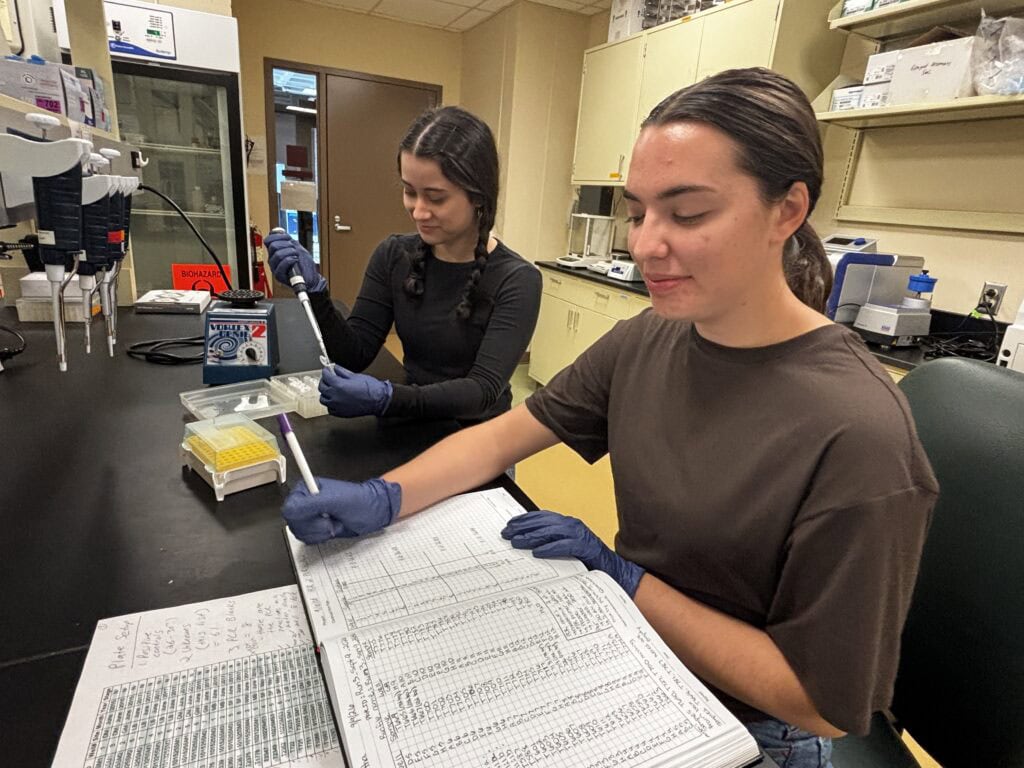
Maya Suarez spends any spare time she has between her two majors, biology and math, in the Molecular Biology research laboratory on Vermont State University’s Johnson campus, where she is entering her senior year. She’s worked there for over three years, performing DNA analyses on blacklegged ticks, the vector of Lyme disease and several other diseases in the eastern United States. More recently, she and her colleagues and mentors have been developing a new CRISPR-based approach for detection of tick-borne pathogens. This summer, she’s trying out a bioinformatics internship, which she hopes to parlay into graduate study next fall.
Maya shared, “The lab work I experienced at Vermont State University opened my eyes to new opportunities and gave me the practical skills I needed to get my summer internship. That knowledge will be really valuable as I pursue my graduate studies. Especially having professional mentors, like my Vermont State University professors. I feel confident taking ownership of my lab work and taking professional risks because I have that strong relationship and trust from them.”
Those Vermont State University professors are Kristen Ross and Bill Landesman, ecologists who study different aspects of Vermont’s tick problem from their home base campuses of Castleton and Johnson. Their research is a collaboration across academic programs that provides hands-on opportunities for students like Maya, and insight on the pathogens ticks carry and the environmental conditions in which they thrive.
In the field, the scientists, and their students, study the role of invasive plant species and environmental factors in maintaining tick populations and the ever-increasing risk of disease transmission. This work is conducted in Rutland County, near the Castleton Campus and is funded by grants from the Centers for Disease Control and the National Science Foundation.
The vegetation project is tied to land management, and they are studying whether it is the species of the plant that matters, the density of the vegetation or both. Most studies on invasive plants and tick populations study suburban and borderline urban areas. But Vermont has a different density of human population, and larger tracks of privately owned land, so the Vermont State University team is studying if and how that matters.
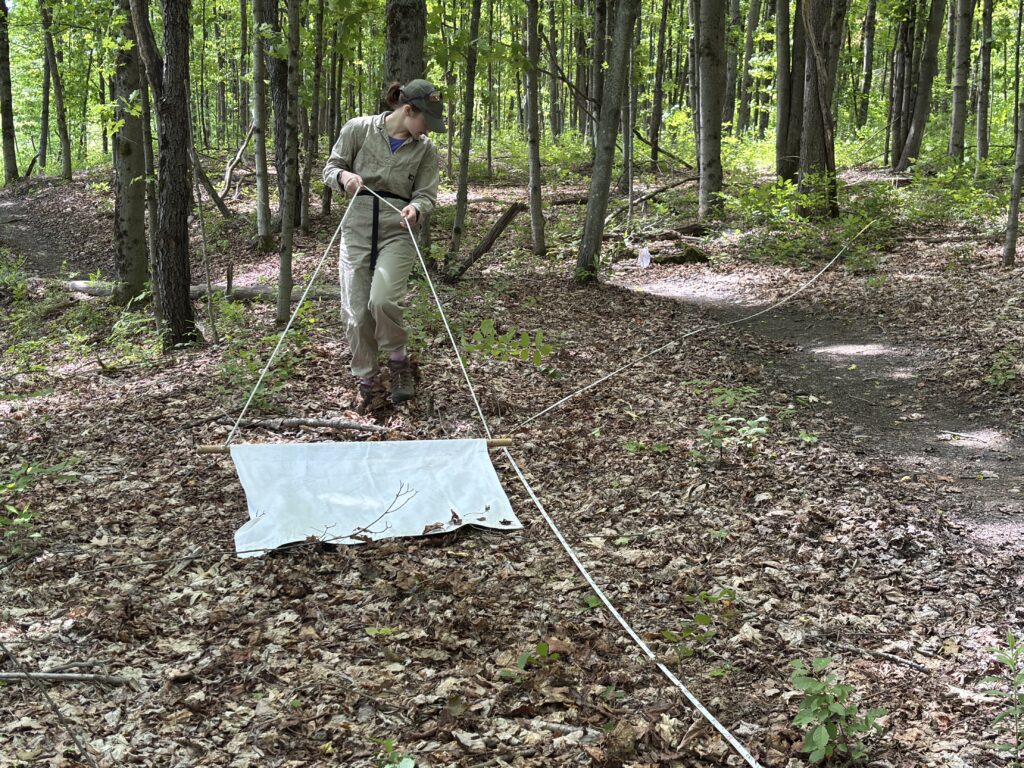
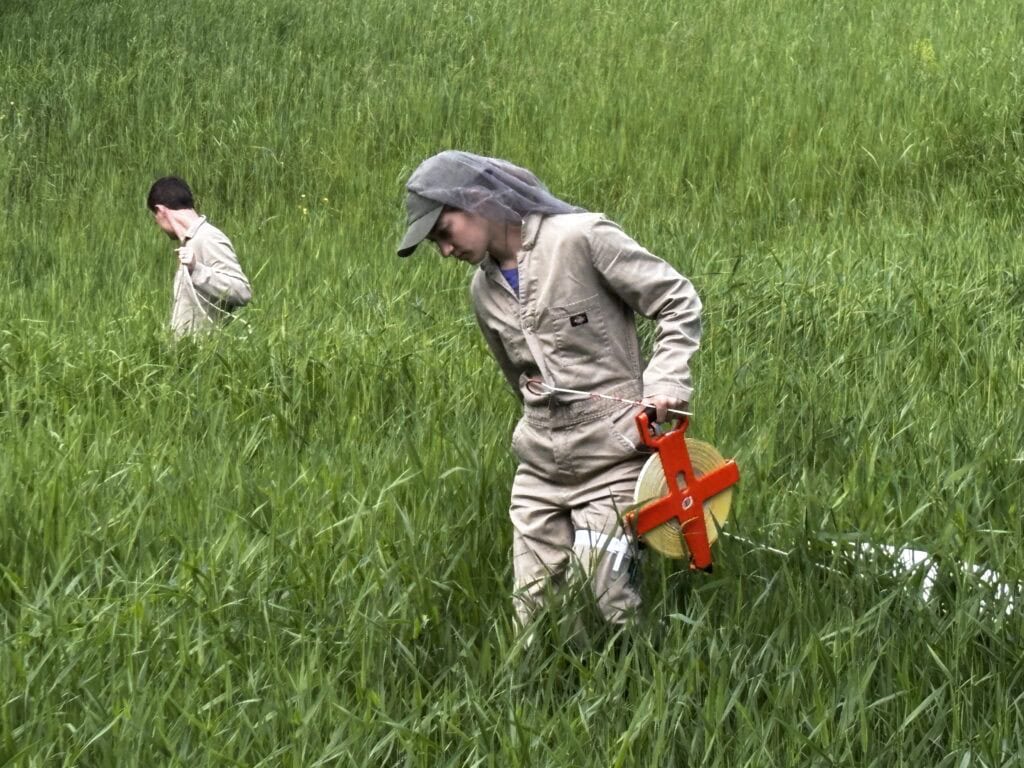
“Right now, especially in New England and in Vermont, landowners are doing land management themselves or are contracting with a forester or other professional to do it for them,” said Dr. Ross. “People are encountering ticks with more frequency and are encountering different species of ticks. There’s a lot of questions out there and a lot of fear, so our goal is to show people how they can get back into the woods with vigilance and safety practices.”
Drs. Ross and Landesman partnered on this project with colleagues at the University of Maine, who are studying similar questions in Maine’s similarly rural environment. The work is additionally funded by the New England Center of Excellence in Vector Borne Diseases, a New England-wide collaboration on which Dr. Landesman serves as a co-investigator.
Dr. Landesman noted that with an understanding of the ecology of blacklegged ticks, Vermonters can pursue outdoor recreation without fear. As we enter the period of peak activity of adult blacklegged ticks (October and November), he recommends:
- Blacklegged ticks, also known as deer ticks, are most commonly found in forests and forest edges and can be found on lawns, in landscaping and at the lawn/forest interface.
- Be especially vigilant after walking through vegetation, including plants such as honeysuckle and Japanese barberry.
- After returning from a tick-infested area, place your clothing in the drier on high for about 10 minutes. This will kill any ticks on your clothing.
- Performing tick checks twice per day is a great preventative measure. In addition, treating your shoes with repellants containing permethrin can be very effective.
- The length of time a blacklegged tick is attached to a person matters. The risk of transmitting disease is greatest if the tick is attached for more than 24 hours if the tick is already infected with the Lyme disease pathogen (approximately 20-50% of blacklegged ticks).
- Anaplasmosis, another disease transmitted by blacklegged ticks, is commonly reported by health officials in Vermont. Blacklegged ticks can transmit Human Babesiosis, a relapsing fever (Borrelia miyamotoi disease) and Powassan virus. These and other pathogens are present in Vermont but are less common.
- Adults (the largest life stage) are most active in October and November, and again in April and May. Nymphs (the second, much smaller life stage) are most active in June, and this is when most cases of Lyme disease are acquired.
Vermont State University’s research project is ongoing and provides ample opportunity for students to engage.
“We’re a teaching university with amazing opportunities for students to learn that prepare them for life after college,” Ross added. “They’re learning how to engage with landowners, what good questions to ask, and how to make observations in the field. All of these things will benefit them whether or not they become researchers themselves. And doing research as an undergraduate, especially with the autonomy we offer our students, is an amazing learning opportunity.”
That was true for Vermont State University Castleton alumni and former research assistant, Deacon Watson (VTSU ‘25). Watson shared, “I was able to apply concepts I had been learning in the classroom directly to the fieldwork. Skills like data management were crucial, as well as keeping practices consistent while dealing with varying conditions day to day. At the end of my term with the project, I was fortunate enough to present the data we had collected alongside the team, both on campus and at a regional conference.”
The skills Watson gained transferred to his work after graduation as well. “Dr. Landesman and Dr. Ross both emphasized the importance of being able to discuss your research,” he added. “Not only for the sake of sharing scientific ideas, but also to ensure that you comprehend the work that you’re doing and can synthesize your ideas into a digestible format. I enjoyed the field work so much that I resolved to do more of it, and by having this research experience on my resume, I was able to get a job working with the vegetation crew at Haleakala National Park in Hawaii.”
“Our laboratory-based research is conducted on the Johnson campus in two state of the art molecular biology research laboratories, and field research is performed in forests close to the Castleton campus, where we have been monitoring tick populations and tick-borne pathogens for over 10 years,” Landesman said. “We are the same academic department across both campuses, so our students share and collaborate. Students from the Johnson campus can participate in summer field research while staying in student housing on the Castleton campus.” This cross-campus collaboration is a key aspect of Vermont State University’s unified model, where students can pursue offerings across campuses or move seamlessly from one to another to follow academic opportunities.
You can visit Vermont State University’s Academic Program website to find out more about programs in biology, environmental science, or wildlife and forest conservation. For more information about ongoing research in tick biology, visit https://vermontstate.edu/directory/william-landesman/ and www.landesmanlab.com.