
This story was originally published by the Rutland Herald on February 10, 2026
Riley Kirk recently visited Phoenix Books to discuss her book, “Reefer Wellness: Understanding Cannabis Science, Culture, and Medicine,” with Vermont State University cannabis studies colleague Dr. Phil Lamy.
Thursday evening consisted of Lamy interviewing Kirk about tailoring cannabis use to the user, and aligning usage with preference and tolerance, as well as an audience Q&A and book signing.
Kirk is a Ph.D.-trained pharmaceutical scientist who specializes in natural product chemistry. Much of her research and work focuses on how cannabis and botanicals influence the body.
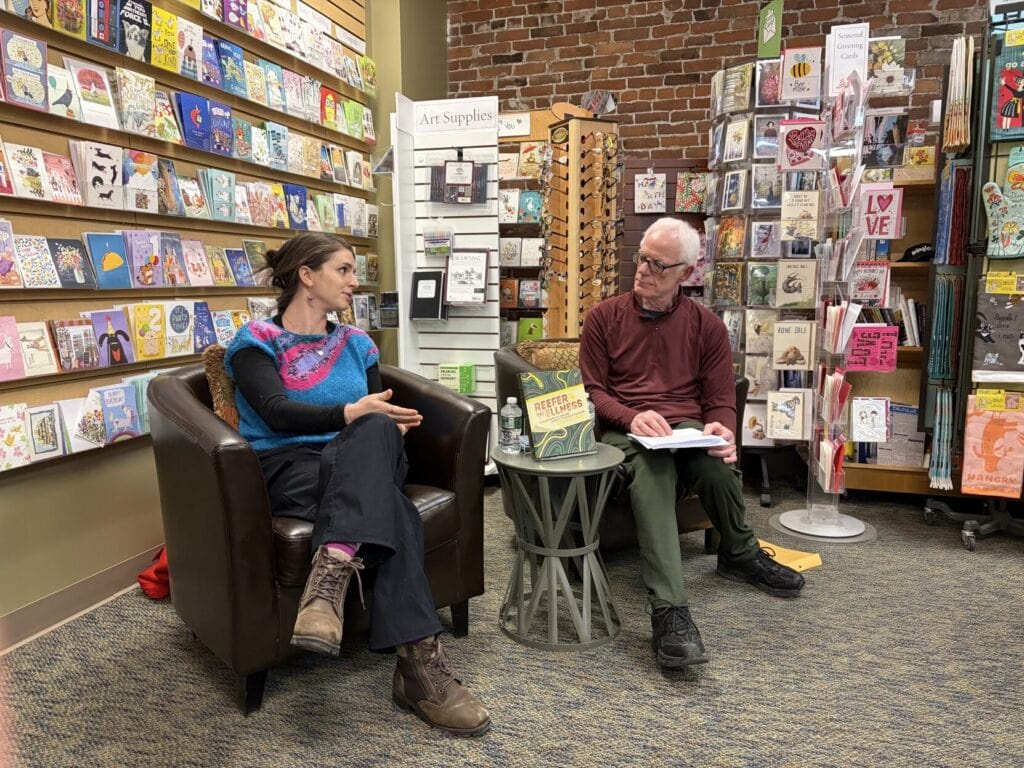
Lamy kicked off the interview by first asking Kirk why and when she started using cannabis.
She said that her first use was at 14 years old but noted, statistically, the first average use of cannabis is found at 14.5 years old.
“When I first used cannabis, my brain just felt normal. I was able to think really clearly. I had seizures when I was younger. I never even put the pieces together until I was in my Ph.D. I realized once I started using cannabis, I never had another seizure in my life, which is pretty incredible. It just made me feel good, made me feel right,” she said.
Kirk said she became fixated on cannabis later in her Ph.D. after noticing how special it was compared to other medicinal plants.
“The way cannabis works in the body, it has almost unlimited potential for so many different diseases or mental conditions. It can control almost anything in the body if we use it right, and we can control the chemistry to some degree,” she said.
Ahead of his next question, Lamy noted that 43 states have a form of legal medical cannabis, whereas 24 states have recreational usage.
“Why is it taking so long for the AMA (American Medical Association), for example, to recognize it? The American Nursing Association does recognize that cannabis is a medicine and promotes the study of it. Cannabis is in this 1970-designed regulatory system, a Schedule I drug. What is this strange paradox that we’re in, and how are we going to address it?” he said.
Kirk said that cannabis will now be rescheduled to a Schedule III drug, as was announced late last year, which would include the government recognizing cannabis as having medical value. She says that what gets in the way of people understanding the medical value is the side effect of getting high.
“It’s very different than what a lot of physicians see as medicine. They’re only going to see a pill in a bottle that’s extremely isolated, dosable and consistent, that is a medicine. If it’s a plant and it has many different things present, it’s too complex, it’s plant medicine, it’s that other type of stuff that herbalists do, but it’s not real medicine,” she said.
When Lamy asked about marijuana myths, Kirk debunked the “lazy stoner” trope.
“Many people are using cannabis to be productive. They’re using it to get them started with the day. This is where the different types of cannabis, the more uplifting cannabis, versus the more sedated cannabis, understanding what those are and being able to choose products for what time of day you’re using it, is incredibly valuable and also very unlike a pharmaceutical product because you’re able to curate the medicine to what you need at that moment,” she said.
“The suggestion that THC levels in today’s marijuana is so much higher and dangerous than it was in the past. That it’s not the same marijuana. Is that a myth? Is that true?” Lamy said.
Kirk said that it is true for the regulated market, and that what people purchase in the dispensary will be very strong. She said that certain varieties will not be as strong, for example, a one-to-one CBD THC variety.
When asked what one of the most surprising things about cannabis is, Kirk said that 20% of people are unable to feel the effects of edibles.
“Some states don’t allow for smokable products. What are these people in these states supposed to do if they can’t feel the effects of edibles? Alabama’s about to open up their medical cannabis market. It’s about to be edibles only. That’s it. So, again, we’re kind of working with them to be like, ‘Love that in theory, but it’s not very practical for a significant amount of the population,’” she said.
Currently, Kirk is teaching a new virtual “Cannabis is Medicine” class across all the VTSU campuses this semester. Her book is available for purchase in-person and online at Phoenix Books in Rutland.