
This story was originally published by the White River Valley Herald on December 11, 2025.
In the works at VTSU Randolph is a project that hopes to bring sustainable, local beef to campuses across the state. The school is partnering with the Northeast Grass-Fed Beef Initiative (NGBI), as well as Sodexo, to establish a local supply chain of beef that can supply food to its campus dining halls.
NGBI is a non-profit organization that works with farmers to achieve sustainability and ecosystem health on their farms. A big goal, shared Lea Camille Smith, spokesperson for the organization, is to influence a shift to 100% grass-fed cattle and keeping beef production for the Northeast in the Northeast.
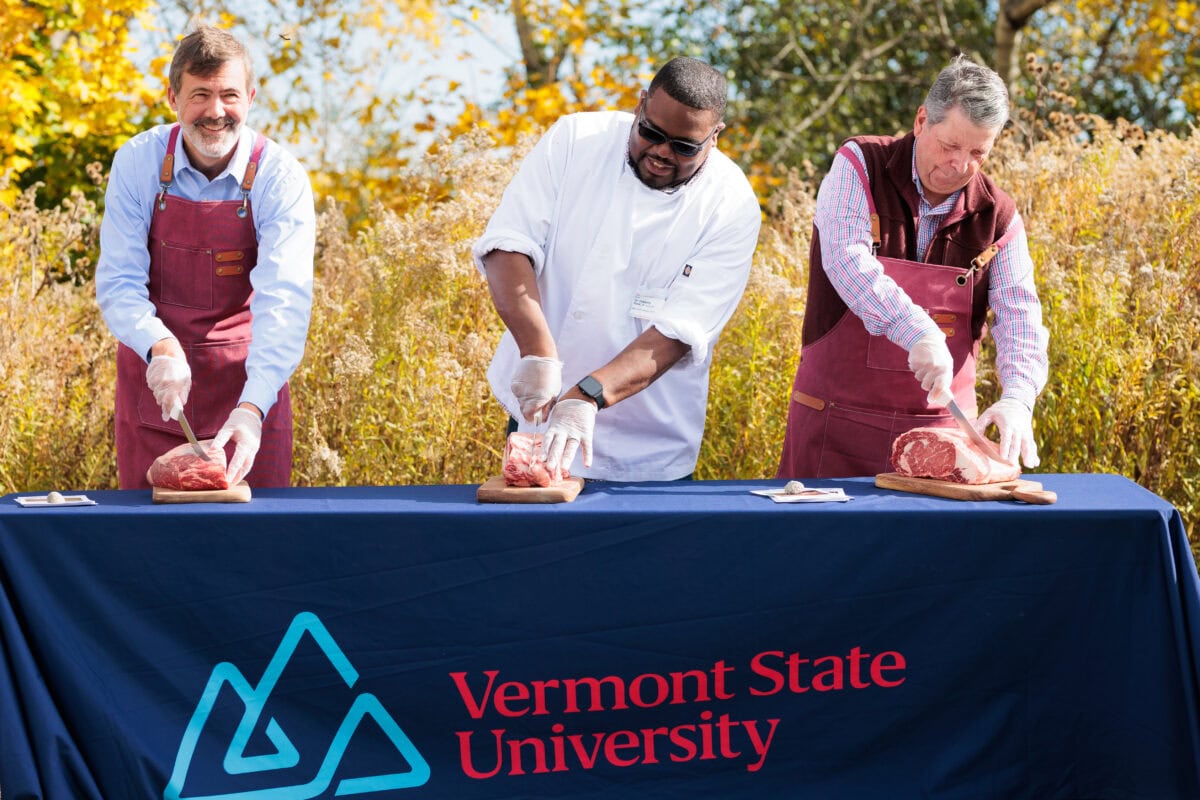
A huge piece of the puzzle is VTSU’s Center for Agriculture and Food Entrepreneurship (CAFE) and the college’s new state-of-the-art meat lab. The space is not only a functional butchery, but a teaching facility. The lab opened in May, and has so far been used mainly for testing, but will welcome its first students this weekend for a two-day introductory course in butchering beef.
Dr. DeMetris Reed Jr., the meat facilities director, is excited about the partnership.
“What we’re doing is working with local producers to purchase their grass-fed cattle, and then they’ll be slaughtered at a local butcher, and then we’ll process the carcasses here,” he said. “We’ll cut the cuts that the campus needs, whether you’re [in] Johnson, Williston, Randolph, or Castleton, and those will be sold to Sodexo.”
Reed proudly showed off the equipment in the lab, including a grinder/mixer, a large smoker—“this weekend we’ll do jerky”—a walk-in freezer, a band saw, and multiple butchering tables.
The entire lab is kept just above freezing to mitigate the possibility of bacterial growth on the meat. Getting to work somewhere cool is one of the things that initially attracted Reed to the meat processing trade. He had a professor during his undergraduate studies in Texas that opened his eyes to it.
“He told me, ‘if you want a job that doesn’t require you to be hot all day…I can give you a job that you’ll stay cool, you’ll make some money, and you’ll get to taste some things,’” Reed said.
Reed shared that the facility is waiting on a regulatory inspection before the meat can be used in the dining halls. For now, he said, meat that’s butchered there will either go home with students or be given as gifts to donors to the school, because “we want to say thank you to them.”
This weekend’s class is designed to use the entire facility with all of its bells ad whistles. “What I’m looking forward to is just getting this all used. We’ll be able to use all the stuff, the grinder, everything, all in one weekend. Right now, I’ve been doing it in pieces just to test everything out,” Reed said. “But this weekend, we’ll use the band saw, we’ll use the smoker, we’ll use the mixer, and we’ll be making jerky, and we’ll make a little bit of sausage. So they’ll get a full-on interactive class that is usually kind of separate into like four different classes, but I really wanted to give an opportunity to see what this room can actually provide.”
VTSU received a grant from Henry P. Kendall Foundation that has been supporting the project. One thing that Reed hopes that money will be able to contribute to is a refrigerated trailer to transport carcasses to Randolph and then processed meat to other campuses.
The butchery is the only university meat processing facility in the state, despite the fact that Vermont has multiple meat packing facilities. Reed said the school hopes to launch a year-long certificate program that would prepare students to work in a Vermont packing facility, but that is presently still in the works.
“We’re trying to build a conveyer to students from here to the processors in the state, small processors,” Reed said. “From Vermont packing house, to Ferrisburg, all the way to the Northeast Kingdom to the islands, wherever you have a packing facility, a butcher shop, and you need someone that’s got skilled labor … they can come here and learn it.”
According to a press release from VTSU, building a local supply chain will benefit the Vermont economy, too. Currently, ground beef is sourced locally for the university, but “other cuts come from national suppliers at rising costs.”
Folks interested in learning more about the facility or taking a class can visit the older VTC agriculture and food systems website (the VTSU website hasn’t yet been updated with the newest meat facility information) or email Reed at DeMetris.Reed@VermontState.edu.
“You can email me directly if you’re interested in how your meat is processed, if you’re interested in becoming a meat processor, if you’re just curious about doing something on the side, if you just saw a video on YouTube…there’s no limit to what you can do here,” Reed said.